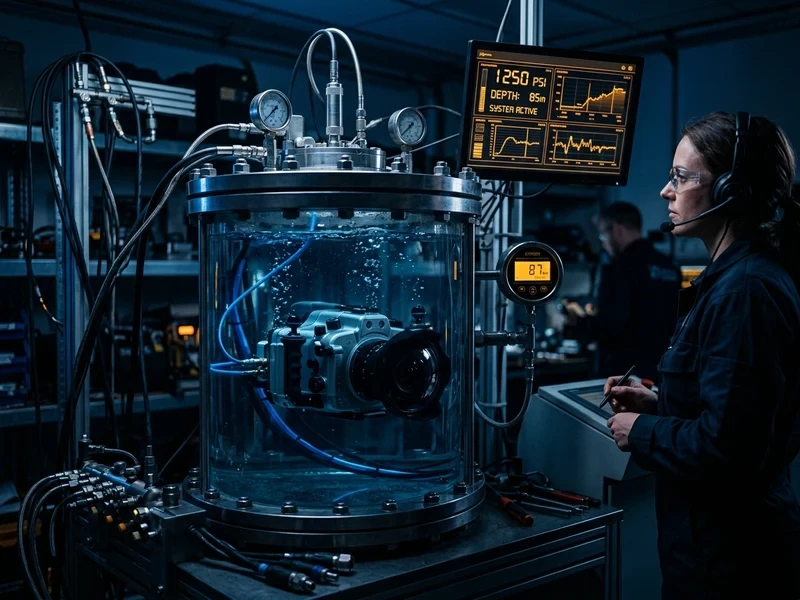
Deep-sea imaging systems and underwater camera housings are exposed to extreme hydrostatic pressure and aggressive saltwater corrosion from the design stage through field deployment. Every additional 10 meters of depth adds approximately 1 bar (about 1 kg/cm²) of pressure. Protecting professional cinema cameras at depths of 100 or 300 meters therefore demands mechanical design to micron-level tolerances and rigorous testing protocols.
The test cycles used in the Cinedepth engineering laboratory consist of two main stages: preliminary vacuum leak analysis and hydrostatic pressure-chamber validation. Once the housing is sealed, negative pressure is applied through the integrated vacuum valve, and digital differential-pressure sensors monitor the internal pressure for at least 30 minutes. This process identifies capillary O-ring leaks or assembly faults before the equipment is deployed.
In underwater engineering, a single micron of surface irregularity or a deformed O-ring can allow water to reach camera equipment worth tens of thousands of dollars. That is why every design is tested at no less than 1.5 times its intended operating pressure.
During pressure-chamber testing, our dedicated hyperbaric test tank simulates the intended underwater operating environment. Controlled ramp-up, dwell at maximum depth, and ramp-down stages are used to measure the housing’s elastic deformation limits and verify the focus stability of the optical dome port.
Critical Sealing Principles
Dual-Stage O-Ring Geometry: Two independent barriers across radial and axial compression zones.
Hard-Anodized 6082/7075 Aluminum: A 50-micron hard-anodized layer that resists saltwater corrosion and surface damage.
Pressure-Rated Optical Domes: Finite element analysis (FEA) is used to control deformation in acrylic and optical-glass ports.
Stainless-Steel Penetrators: Custom resin-potted feedthroughs prevent water migration along cable jackets under high pressure.
Every underwater camera housing designed by Cinedepth is validated through these stringent laboratory tests before release. Divers and production crews can then remain focused on the shot and the mission beneath the surface.